
When Ned Ludd smashed mechanical looms in 1811, he wasn't just railing against machines — he was fighting for his livelihood, his community, and a way of life threatened by a rapidly changing world. Fast forward to today, and knowledge workers are voicing similar anxieties about AI adoption in the workplace, fearing the disruption — and potential displacement — that artificial intelligence may bring.
The parallels are striking. As businesses accelerate their enterprise AI adoption in 2026, understanding the historical context of technological revolutions is no longer a luxury, but a necessity for making informed decisions and navigating the complexities of workforce transformation. Let's dive into how the Industrial Revolution offers a surprisingly relevant roadmap for AI integration at work.
Every Transformative Technology Follows the Same Disruption Curve
The introduction of the spinning jenny, the steam engine, and later, mass production techniques, sparked profound economic and social upheaval. Fortunes were made, but traditional skills became obsolete, leading to widespread unemployment and social unrest. Today, we see a similar pattern emerging with the rise of AI. While AI promises increased efficiency and new possibilities, it also raises concerns about the future of work, especially for roles involving routine or easily automated tasks.
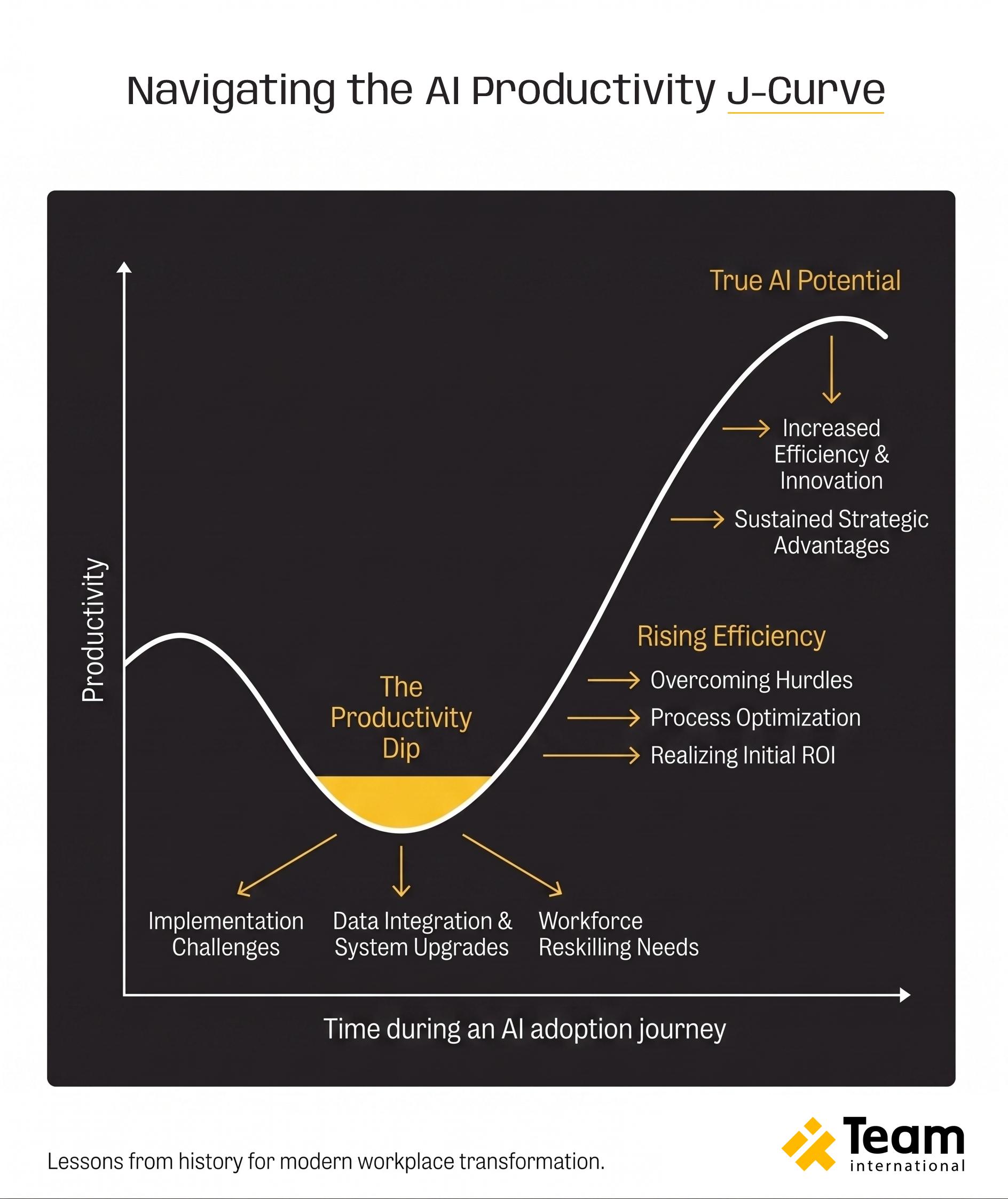
The Productivity J-Curve: Why AI Feels Slow Before It Feels Fast
One crucial concept to understand is the "AI productivity paradox." Just as the benefits of early industrial technologies took time to materialize, enterprise AI adoption often follows a "J-curve." Initial investments in AI systems may lead to decreased productivity as organizations grapple with implementation challenges, data integration, and the need for new skills. It's only after these initial hurdles are overcome that the true potential of AI — including increased efficiency and innovation — becomes apparent. This initial dip in the curve explains why many businesses feel they aren't seeing immediate ROI from their AI investments.
General-Purpose Technologies Then and Now: Steam Engines to Large Language Models
The steam engine, a quintessential invention of the Industrial Revolution, is considered a "general-purpose technology" (GPT). GPTs are characterized by their ability to improve upon themselves and drive innovation across multiple sectors. Large language models (LLMs) like GPT-4 are the modern-day equivalent. Just as the steam engine revolutionized manufacturing, transportation, and agriculture, LLMs are poised to transform industries ranging from customer service to software development. Recognizing AI as a GPT and planning for its pervasive impact is crucial for long-term strategic success.
Will AI Replace Jobs the Way Machines Replaced Mill Workers? The Honest Answer
The impact of AI on jobs is a complex and multifaceted issue. The historical record offers some comfort. Friedrich Engels, observing the grim conditions of the working class in 19th-century England, documented the social costs of industrialization. However, history also demonstrates that technological advancements, while initially disruptive, ultimately create more jobs than they destroy — albeit with a significant lag and requiring significant adjustments.
What History Actually Shows About Net Job Creation After Automation Waves
History shows that while automation eliminates specific tasks, it also creates new ones — often in unforeseen areas. The Industrial Revolution led to the rise of entirely new industries, from railway construction to mass retail. Similarly, AI is expected to generate new job categories in areas like AI development, data science, AI ethics, and human-AI collaboration. However, this transition requires proactive efforts in AI reskilling workers and adapting education systems to meet the demands of the evolving job market.
Which Roles Face the Highest AI Displacement Risk in 2026
While net job creation is the long-term trend, short-term AI job displacement is a real concern. The World Economic Forum's Future of Jobs Report 2025 projects that AI and automation will lead to the displacement of 85 million jobs globally by 2025, while also creating 97 million new roles. Using the Autor-Levy-Murnane task framework, jobs involving routine and codifiable tasks are most susceptible to automation by RPA (robotic process automation) and AI. This includes roles in data entry, customer service, and certain types of administrative work. However, roles requiring creativity, critical thinking, and complex problem-solving skills are likely to remain in high demand.
Why Workers Resist AI Adoption — and Why That Resistance Is Rational
The Luddite movement, though ultimately unsuccessful in halting industrialization, highlights a critical point: resistance to technological change is often rooted in legitimate concerns about job security, economic inequality, and loss of control. Today, workers may resist AI adoption because they fear job displacement, lack the skills to work alongside AI systems, or perceive AI as a threat to their autonomy. Addressing these concerns is crucial for successful AI integration. Effective change management, transparent communication, and employee involvement in the AI adoption process can help mitigate resistance and foster a more collaborative environment.
Reskilling at Scale: What Industrial-Era Apprenticeships Tell Us About AI Training Today
During the Industrial Revolution, apprenticeships played a vital role in transmitting skills and knowledge from one generation to the next. Today, a similar approach is needed to equip workers with the skills necessary to thrive in the age of AI. Organizations must invest in comprehensive AI reskilling programs that focus not only on technical skills, but also on "soft skills" like communication, collaboration, and critical thinking. As Daron Acemoglu's displacement research emphasizes, actively fostering new skills is the best way to combat the negative impacts of automation. Training programs should emphasize augmentation — using AI to enhance human capabilities — rather than pure automation that replaces humans entirely.
The 3 Moves That Separate AI Leaders From Laggards in 2026
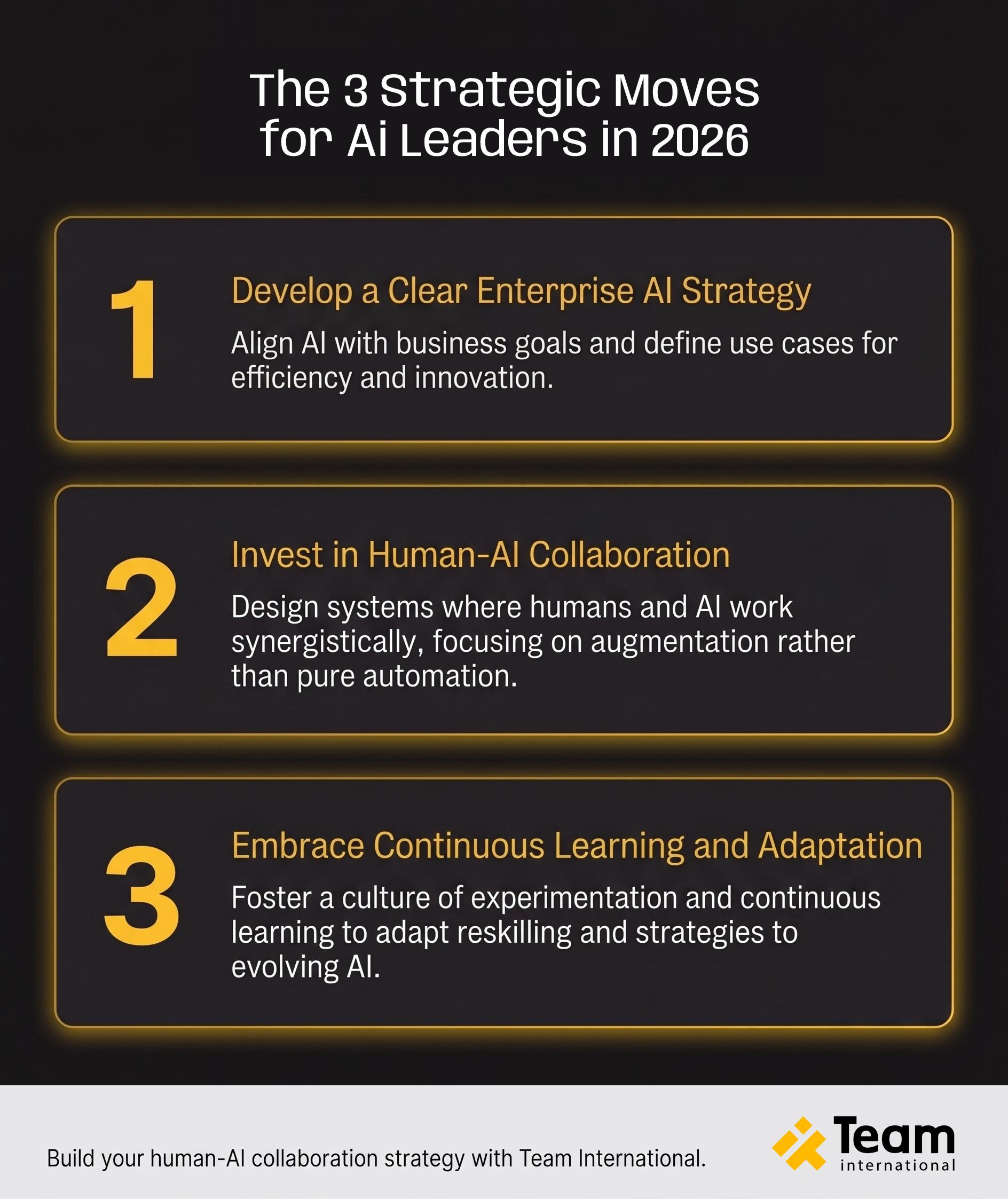
To successfully navigate the AI revolution, organizations must adopt a proactive and strategic approach. Based on current enterprise AI adoption rates and emerging best practices, here are three key moves that will separate AI leaders from laggards in 2026:
-
Develop a clear enterprise AI strategy: A well-defined AI strategy should align with the organization's overall business goals and outline specific use cases for AI. This includes identifying opportunities for AI to improve efficiency, enhance customer experiences, and drive innovation. An enterprise AI readiness framework can help guide your strategy development.
-
Invest in human-AI collaboration: Focus on creating systems where humans and AI work together synergistically. This requires designing AI tools that augment human capabilities rather than simply replacing them. It also involves training workers to effectively collaborate with AI and leverage its strengths to improve their performance.
-
Embrace continuous learning and adaptation: The field of AI is constantly evolving, so organizations must be prepared to adapt their strategies and reskilling programs accordingly. This requires fostering a culture of continuous learning and experimentation, and staying abreast of the latest advancements in AI technology.
The Industrial Revolution provides valuable lessons for navigating the AI revolution. By understanding the historical context of technological change, anticipating potential challenges, and investing in the workforce, businesses can unlock the full potential of AI and create a more prosperous and equitable future.
Ready to move from historical insight to a concrete AI adoption roadmap? Explore how TEAM International helps enterprises build human-AI collaboration strategies that stick. Learn more about our AI adoption and implementation services.