
As enterprises race to leverage the transformative potential of artificial intelligence, the fervor surrounding enterprise AI adoption in 2026 feels remarkably similar to the dot-com boom of the late 1990s. Vast sums are being invested, expectations are soaring, and every company fears being left behind. But history offers a cautionary tale: not all revolutions deliver on their promises, and many early adopters fall victim to hype and unsustainable strategies. This article draws actionable digital transformation lessons from the dot-com era to help today's enterprise leaders avoid repeating costly mistakes and build an AI adoption strategy that actually delivers long-term value.
The Pattern Is Familiar: Why 2026's AI Frenzy Rhymes with 1999
The late 1990s were characterized by irrational exuberance around the internet. Companies with flimsy business models and unproven technology commanded astronomical valuations. Today, we see echoes of that era in the enthusiasm surrounding large language models (LLMs) and AI-driven solutions. While the underlying technology is undeniably powerful, the rush to implement AI without a clear strategy or solid foundation risks creating another bubble.
Where the Dot-Com Era Actually Went Wrong (It Wasn't the Technology)
The dot-com bubble didn't burst because the internet was a bad idea. It collapsed because of fundamental flaws in business strategy and execution. Companies were overvalued based on "eyeballs" rather than revenue, infrastructure couldn't support rapid growth, talent was scarce and overpriced, and governance was non-existent. As Geoffrey Moore pointed out in Crossing the Chasm, many companies failed to transition from early adopters to the mainstream market. These dot-com bubble lessons are strikingly relevant to the AI implementation challenges facing enterprises today.
How Today's Enterprise AI Investments Are Repeating the Same Structural Mistakes
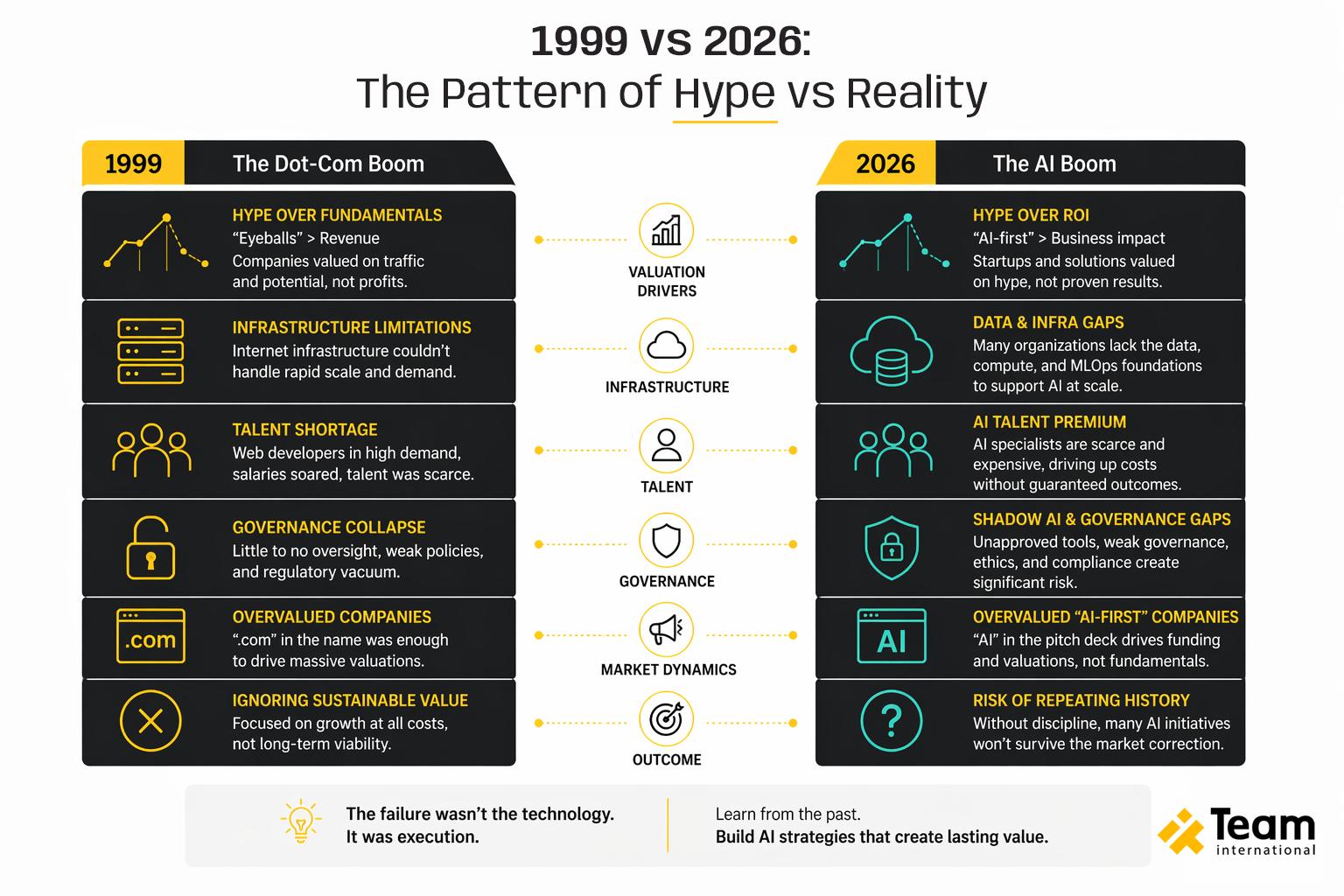
In 2026, many organizations are treating AI as a magic bullet, throwing resources at pilot projects without a coherent enterprise AI strategy. They are overspending on cutting-edge platforms like Microsoft Azure AI, Google Cloud Vertex AI, or AWS Bedrock without adequately addressing data quality, infrastructure limitations, or the need for a robust AI governance framework. The result is often "pilot purgatory" — a graveyard of promising AI projects that never make it to production or deliver meaningful AI ROI for enterprises.
Specific parallels between the dot-com era and today's AI landscape include:
-
Overvaluation of "AI-first" companies: Just as companies with ".com" in their name saw their stock prices skyrocket regardless of fundamentals, startups pitching AI solutions are often valued based on hype rather than demonstrable results.
-
Infrastructure limitations: The internet infrastructure of the late 90s couldn't handle the traffic demands of burgeoning e-commerce. Similarly, many organizations lack the data infrastructure, compute power, and MLOps capabilities needed to support large-scale AI deployments.
-
Talent shortage and inflated salaries: The demand for web developers and programmers during the dot-com boom led to exorbitant salaries and a shortage of qualified talent. Today, AI specialists are commanding similar premiums, often leading to a drain on resources without a corresponding increase in productivity.
-
Governance collapse: Unfettered growth and a lack of regulatory oversight characterized the dot-com era. Today, the absence of robust AI ethics guidelines, data privacy protocols, and an automation governance model creates significant risks for enterprises deploying AI.
-
Ignoring change management: Launching AI can impact roles and responsibilities across the business. Neglecting change management will lead to poor adoption of systems from staff and a failure to achieve AI ROI.
What Separated Dot-Com Survivors from Casualties — and What It Means for AI Today
Not all dot-com companies perished. Amazon, for example, survived and thrived by focusing on long-term value creation, disciplined infrastructure investment, and customer-centric innovation. Understanding the differences between survivors and casualties offers valuable insights for enterprises navigating the technology adoption lifecycle of AI.
Amazon vs. Pets.com: The Infrastructure Discipline That Made the Difference
The story of Amazon versus Pets.com is a stark illustration of infrastructure discipline. Pets.com, with its expensive marketing campaigns and unsustainable business model, burned through capital and collapsed in less than two years. Amazon, on the other hand, invested heavily in building a robust fulfillment network, optimizing logistics, and creating a seamless customer experience. This focus on infrastructure enabled Amazon to weather the dot-com crash and emerge as a dominant force in e-commerce.
Today, enterprises must adopt a similar approach to enterprise AI adoption. They need to invest in building a solid data foundation, developing robust MLOps pipelines, and ensuring that their IT infrastructure can support the demands of AI-powered applications. Without this infrastructure discipline, even the most promising AI initiatives are doomed to fail.
The 3 Traits of Enterprises Whose AI Adoption Actually Scales Past the Pilot
Enterprises that successfully scale AI beyond the pilot phase share three key characteristics:
-
Strategic alignment: AI initiatives are tightly aligned with business objectives and deliver measurable value. There is a clear understanding of how AI will contribute to revenue growth, cost reduction, or improved customer experience.
-
Data-driven culture: Data is treated as a strategic asset, and there is a strong emphasis on data quality, data governance, and data literacy. Teams are equipped with the skills and tools they need to access, analyze, and utilize data effectively.
-
Iterative approach: AI projects are approached iteratively, with a focus on continuous learning and improvement. Organizations embrace agile methodologies, experiment with different approaches, and are willing to adapt their strategies based on feedback and results.
Is Your AI Initiative Stuck in 1999? A Self-Diagnosis Framework for Enterprise Leaders
To avoid repeating the mistakes of the dot-com era, enterprise leaders should conduct a thorough self-assessment of their AI initiatives. The following questions can help identify potential weaknesses and areas for improvement:
-
Strategy: Is your AI strategy clearly defined and aligned with your business objectives? Do you have a clear understanding of the potential ROI of your AI investments?
-
Infrastructure: Do you have the necessary data infrastructure, compute power, and MLOps capabilities to support your AI initiatives? Are you investing in building a scalable and resilient AI platform?
-
Talent: Do you have the right talent in place to develop, deploy, and manage AI solutions? Are you investing in training and development to upskill your workforce?
-
Governance: Do you have a robust AI governance framework in place to ensure that your AI initiatives are ethical, transparent, and compliant with regulations?
-
Change management: Are you prepared to manage the organizational changes that will result from AI adoption? Are you communicating effectively with your employees and stakeholders?
If you answer "no" to several of these questions, your AI initiative may be at risk of repeating the mistakes of the dot-com era. This enterprise AI readiness assessment can provide a starting point for identifying areas for improvement.
The Governance Gap: Why Most Enterprise AI Programs Fail Before They Scale
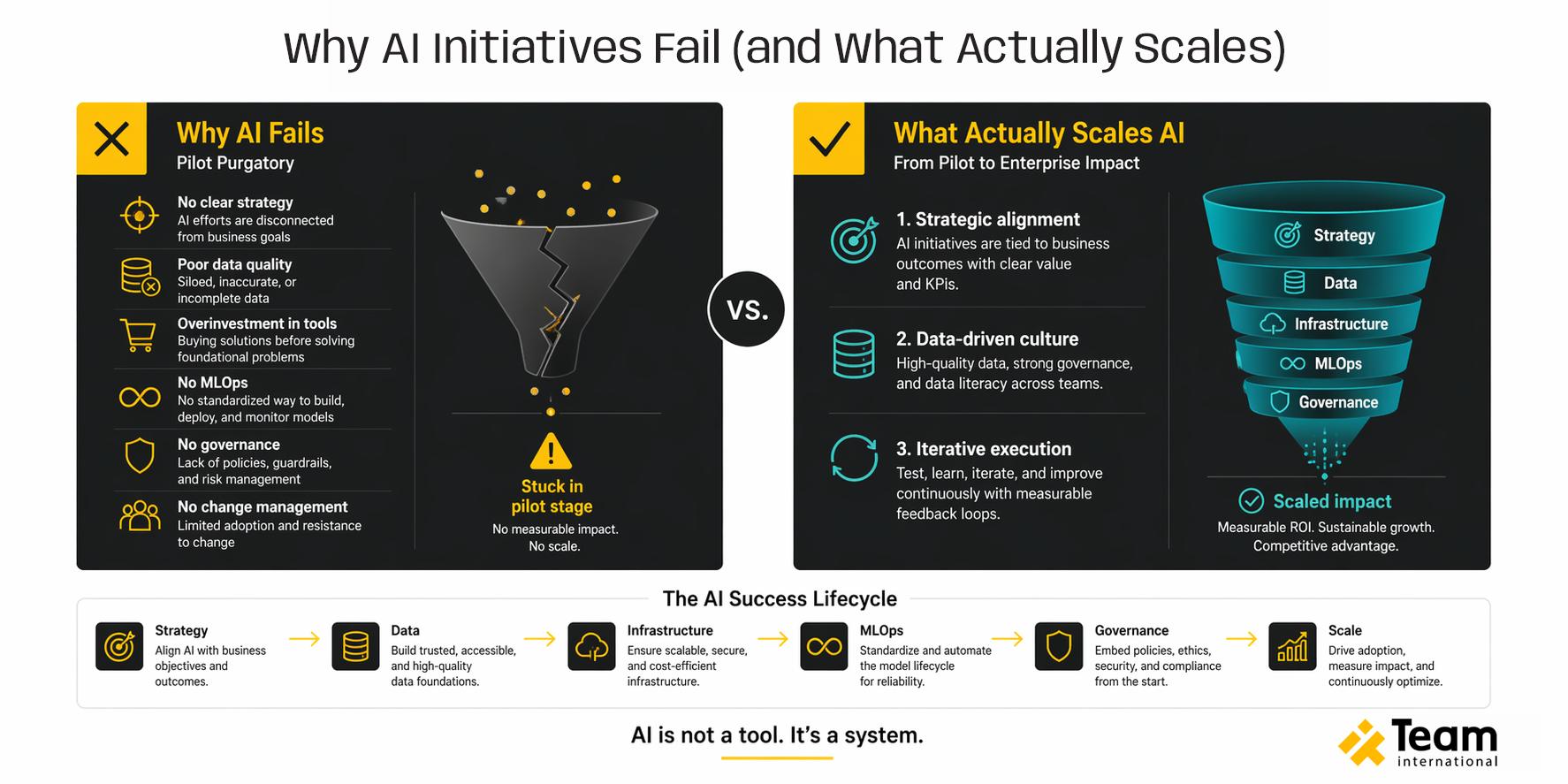
One of the most significant risks facing enterprises adopting AI is the lack of adequate governance. Without a comprehensive data governance framework for AI initiatives, organizations are vulnerable to ethical breaches, data privacy violations, and regulatory penalties. "Shadow AI" — the proliferation of unapproved AI tools and models — further exacerbates this problem.
An effective AI governance framework should address the following key areas:
-
Data ethics: Establishing clear ethical guidelines for the use of AI, ensuring that AI systems are fair, unbiased, and transparent.
-
Data privacy: Implementing robust data privacy protocols to protect sensitive information and comply with regulations such as GDPR and CCPA.
-
Risk management: Identifying and mitigating the potential risks associated with AI, including model drift, adversarial attacks, and unintended consequences.
-
Compliance: Ensuring that AI systems comply with all applicable laws and regulations, including industry-specific standards.
-
Accountability: Establishing clear lines of accountability for the development, deployment, and management of AI systems.
How to Build an Enterprise AI Strategy That Survives the Inevitable Correction
The Gartner Hype Cycle predicts a trough of disillusionment for AI, just as there was after the initial internet boom. To build an enterprise AI strategy that survives this correction, organizations must focus on long-term value creation, disciplined execution, and responsible innovation. Key recommendations include:
-
Focus on solving real business problems: Don't chase the latest AI hype. Instead, identify specific business challenges that can be addressed with AI and focus on delivering measurable results.
-
Invest in building a solid data foundation: Data is the fuel that powers AI. Invest in building a robust data infrastructure, ensuring data quality, and establishing effective data governance.
-
Develop a robust MLOps pipeline: MLOps is essential for deploying and managing AI models at scale. Implement a robust MLOps pipeline to automate the process of building, testing, and deploying AI models.
-
Prioritize AI ethics and governance: Ensure that your AI initiatives are ethical, transparent, and compliant with regulations. Establish a robust AI governance framework to mitigate risks and ensure accountability.
-
Cultivate a culture of continuous learning: AI is a rapidly evolving field. Invest in training and development to upskill your workforce and foster a culture of continuous learning and innovation.
Just as Amazon emerged from the dot-com bubble stronger than ever, enterprises that adopt a disciplined and strategic approach to AI will be best positioned to thrive in the long run. Contact our enterprise AI implementation partner team at TEAM International's AI Studio for a structured enterprise AI adoption consultation — find out if your AI initiative is built to last, not just to launch.
Is your AI initiative built to last? Download the AI Agents whitepaper to take the next step, or learn more about building an automation governance model to manage AI adoption effectively.