Most companies today invest in technology not just to boost operational efficiency, but to compete in an increasingly demanding market and close the talent gap. As a result, the global industrial IoT solutions market is exploding — from $276.6 billion in 2025 to a projected $964.16 billion by 2035. While 92 percent of manufacturers say smart manufacturing solutions will drive their competitiveness over the next three years, most still struggle to move beyond pilot projects or unlock the full potential of these tools. The real problem goes beyond technology. It revolves around implementation, leadership, and unreal expectations.
Off-the-shelf IoT platforms promise quick wins but fail to address unique processes, equipment, and long-term goals. That leads to the main issue: generic solutions that can't scale with your business or integrate seamlessly with existing systems. So, it's time to answer the question: why should custom IoT in manufacturing be your priority, and how to build solutions that deliver real ROI?
The Role of IoT in Manufacturing Transformation
The days of waiting for equipment to fail or relying on scheduled maintenance windows are over. IoT for manufacturing transforms operations by connecting machines, products, and systems into a unified data ecosystem. According to Deloitte, manufacturers implementing IoT solutions see a 10 to 20 percent improvement in production output, a 7 to 20 percent boost in employee productivity, and unlock 10 to 15 percent more capacity. And adoption is only accelerating — 46 percent of manufacturers already leverage industrial IoT solutions, with investments focused on factory automation software, active sensors, and vision systems.
But IIoT doesn't work in isolation. It's a fundamental piece of a larger puzzle — smart manufacturing. Together, AI, data analytics, cloud and edge computing, digital twins, and IIoT create smart factory technologies that deliver what Industry 4.0 promises: connected factories that adapt, learn, and continuously improve.
It allows:
- Real-time supply chain visibility instead of delayed reporting
- IoT asset tracking that eliminates guesswork in inventory and logistics
- Quality control that shifts from post-production inspection to in-process monitoring
Even though IoT is fundamental for optimizing manufacturing operations, it's not a silver bullet for every business challenge. Technology only delivers results when it's designed around your specific processes, equipment, and goals. That's why investing in a custom solution matters more than opting for the fastest deployment.
Why Custom IIoT Platforms Outperform Off-the-Shelf Ones
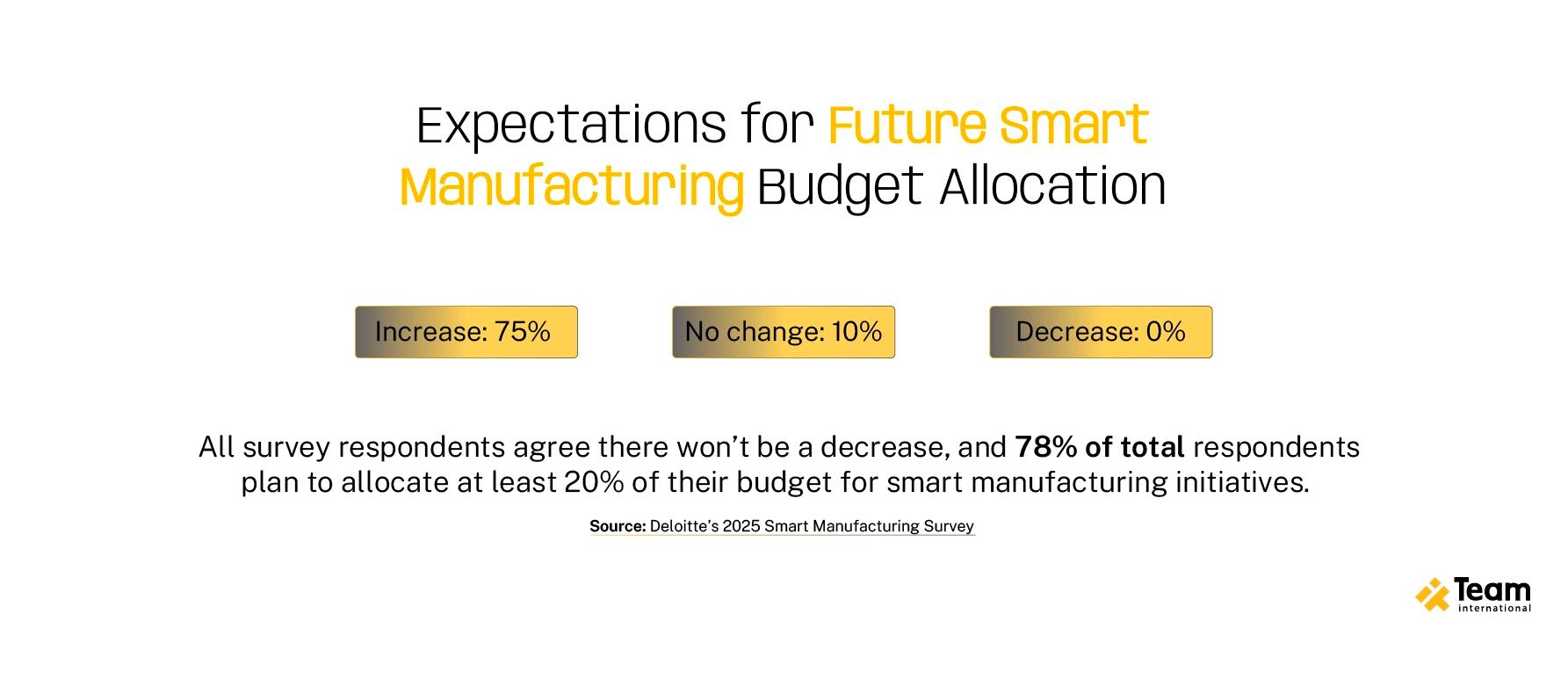
According to Deloitte, 78 percent of manufacturing leaders are allocating at least 20 percent of their overall improvement budget toward smart manufacturing initiatives. That's a significant investment, but generic platforms can't justify that spending when they can't adapt to your reality.
The problem starts with integration and scalability. Off-the-shelf platforms promise ease but deliver middleware nightmares as they can't adapt to your factory reality. Custom IoT software development builds connectors specifically for your equipment, and personalized platforms are architected from day one to support your growth trajectory.
Here's what custom development delivers that off-the-shelf can't:
- Full ownership of your data and intellectual property
- IoT device management tailored to your specific equipment and workflows
- Manufacturing data collection that captures what matters to your operations
- Integration with your existing systems without vendor lock-in
- Flexibility to pivot when business requirements change
The upfront investment in custom IoT software development is higher, and that's a reality. But the total cost of ownership tells the full story. No recurring licensing fees that scale with your growth. No paying for features you don't use. No hitting platform limits that force expensive migrations. You build once, own forever, and adapt as needed — on the go.
Core Components of a Custom Manufacturing IoT Solution
A custom IIoT platform is an ecosystem of components working together to turn raw information into a competitive advantage. Two elements stand out as non-negotiable for your connected factory: robust data analytics that transform metrics into decisions, and scalable device management that keeps your entire infrastructure running reliably.
Robust IoT Data Analytics and Visualization
Your factory generates millions of data points daily, but data without context is just noise. The real challenge is making sense of it fast enough to matter. IoT data analytics platforms serve as the brain of your smart factory. They process raw sensor data in real time, identify patterns humans would miss, and surface insights exactly when you need them.
But analytics mean nothing if stakeholders can't access those insights. That's where visualization becomes critical. Custom, real-time dashboards tailored to different roles — updated as conditions change — are essential for effective decision-making. Historical trend analysis reveals long-term patterns, and mobile access puts critical data in the hands of people on the factory floor.
The three capabilities you need in your IoT data analytics platform:
- Real-time processing for immediate alerts and decision support
- Machine learning models that improve accuracy over time
- Flexible visualization that adapts to different users' work
Scalable IoT Device Management
Your IIoT platform is only as reliable as the thousands of devices feeding it data. Scalable device management handles the entire lifecycle — from provisioning new devices and monitoring connection health to decommissioning old equipment and more. It sounds mundane until you're managing thousands of sensors across multiple facilities. Without rigorous governance and management, your smart factory can easily become a maintenance nightmare.
Custom platforms build device management around your specific infrastructure, and the ROI is clear: manufacturers using IoT sensors with proper device management see a 30 percent reduction in emergency maintenance spending.
Driving ROI: From IoT Predictive Maintenance to Asset Tracking
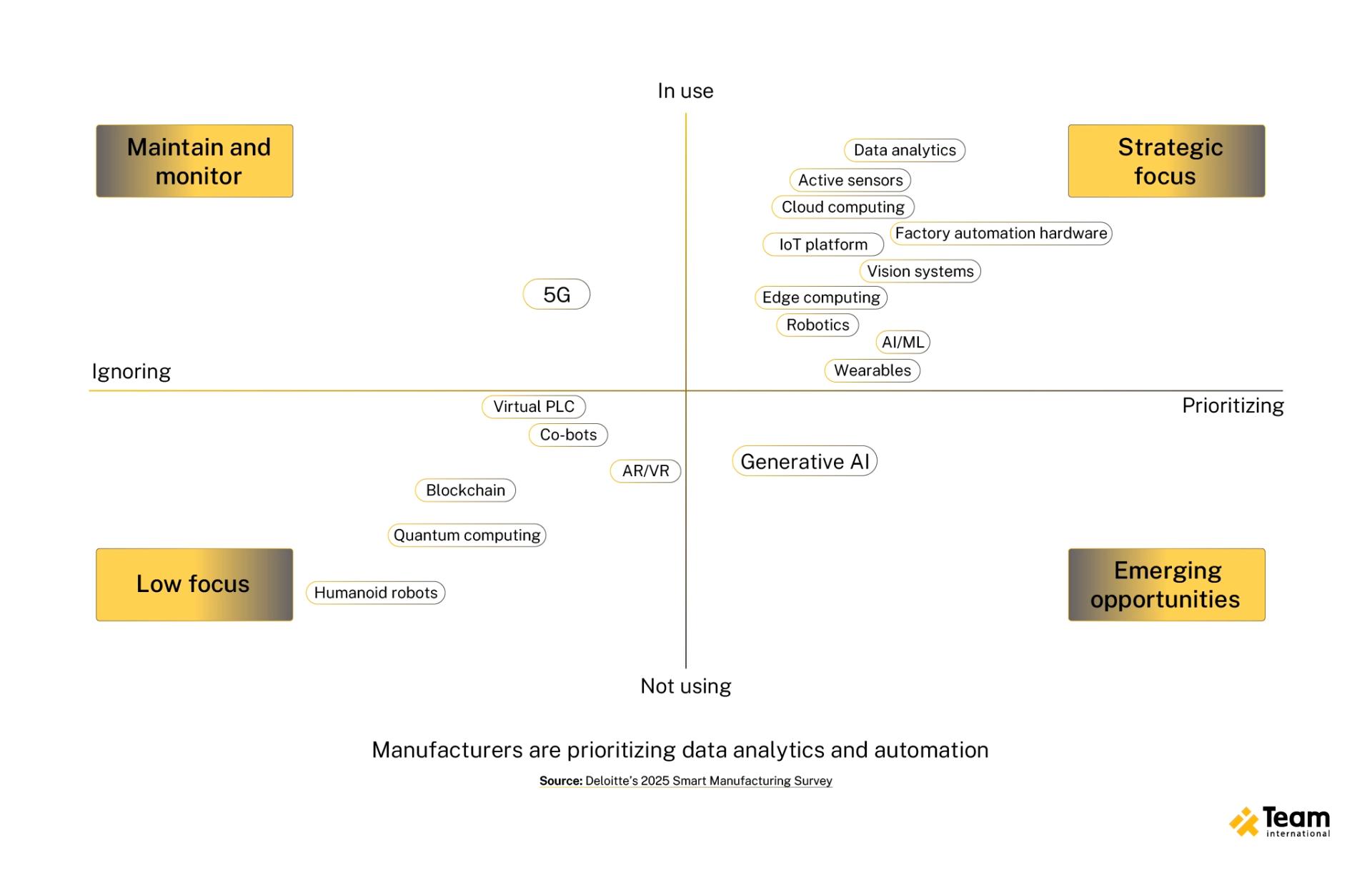
Smart factory technology investments need to deliver measurable returns. Deloitte states that manufacturers are clearly prioritizing data foundations: data analytics, active sensors, cloud computing, factory automation hardware, and IoT platforms. Companies are betting on technologies that solve immediate operational challenges rather than experimental innovations.
46 percent rank process automation as their top priority over the next two years, driven by a harsh reality — 48 percent report moderate to significant difficulty filling production and operations management roles. With 3.8 million net new manufacturing employees required by 2033, smart manufacturing can be the solution.
There are two use cases that will consistently deliver the fastest ROI: IoT predictive maintenance and asset tracking. Predictive maintenance tackles unplanned downtime head-on. Real-time sensor data and ML identify exactly when equipment needs attention, and the impact shows immediately in maintenance budgets and production uptime. IoT asset tracking solves visibility problems across your entire operation.
But what separates leaders from followers is the implementation of custom IoT solutions. Off-the-shelf platforms force you to adapt to their predetermined use cases, but custom platforms adapt to your business priorities and let you solve specific, measurable problems with your long-term goals in mind.
Choosing the Right Partner for Your IoT Software Development
Building a custom platform isn't a six-month project you hand off to any software vendor. IoT implementation challenges are real — integrating legacy equipment with modern protocols, ensuring cybersecurity across thousands of endpoints, scaling infrastructure as you grow, and maintaining system reliability in harsh factory environments.
Look for proven expertise in manufacturing data collection, edge computing architectures, and OT/IT convergence. Ask about their approach to security from the device level to the cloud. Verify they understand your industry's compliance requirements and regulations. And most importantly, ensure they're committed to a long-term partnership, not just initial deployment.
The right vendor doesn't just build what you ask for — they challenge your assumptions, recommend better approaches, and design solutions that scale beyond your current needs. You deserve a tech partner that treats it that way.
Talk with our experts and discover how we can elevate your game with the best-fitting industrial IoT solution that adapts to your goals and ambitions.